Last week, LabXhchange360 attended the 32nd Annual Executive War College (EWC) in New Orleans. EWC is the premier event for leaders across diagnostics, laboratory operations, and healthcare revenue cycle management. With over 1,000 lab executives and 128 sessions, the conversations were timely, forward-looking, and in many cases, urgent.
Two themes dominated nearly every discussion:
- Digital pathology is accelerating rapidly
- Laboratory revenue cycle management is under increasing pressure, with AI front and center in nearly every conversation
But beyond the headlines and keynote talking points, one observation stood out more than anything else:
There is still a major gap between what the industry is discussing and what laboratories are actually implementing.
The industry is focused on the future. Labs still need solutions today.
As it should be, AI was everywhere at Executive War College. There was discussion of predictive analytics, autonomous workflows, intelligent billing, and next-generation operational efficiency. The excitement is understandable. AI will absolutely reshape the future of laboratory operations and revenue cycle management. We’ve also written about the practical applications of AI for medical labs, of which there are many.
But while many organizations await the next wave of innovation, significant financial and operational problems remain unresolved.
And the reality is this:
Many of the largest laboratory revenue cycle management opportunities do not require waiting for future AI capabilities. They are solvable right now.

“What stood out most at Executive War College, was how many labs are still struggling with disconnected systems and manual workflows. The opportunity right now is creating operational alignment across LIS, RCM, EMR, and commercial systems. The organizations winning are the ones investing in upstream validation.”
The Biggest Revenue Leaks are Happening Upstream
One of the clearest themes emerging from conversations at Executive War College was how much preventable revenue loss still originates upstream. The biggest breakdowns often happen before a specimen is ever processed.
Areas like:
- Eligibility verification
- Order integrity
- Prior authorization
- Medical necessity validation
- Upstream workflow control
- Real-time visibility across systems
- Lab billing error prevention
- Lan claim denial reduction
- Pre-test financial validation
These issues continue to create downstream denials, delayed reimbursement, write-offs, rework, and administrative burden. They also contribute directly to lab claim denials, insurance eligibility errors, and avoidable revenue leakage.
To make matters worse, we know that 10-15% of claims are denied upon first submission and that 50-65% of denied claims are never resubmitted or appealed. XiFin pins this at a loss of about $40 billion each year.
And in many cases, laboratories are still managing these workflows through disconnected systems, manual intervention, spreadsheets, and reactive processes.
Laboratory Workflow Automation is No Longer Optional
What became increasingly clear throughout the conference is that operational automation, while critical, is more of a requirement for financial survival than a competitive advantage.
Laboratories are under pressure from every direction:
- Shrinking reimbursement
- Increasing payer complexity
- Staffing shortages
- Higher administrative burden
- Growing patient responsibility
- Expanding compliance requirements
The labs that succeed over the next several years will be the ones that build operational infrastructure capable of preventing revenue leakage before claims are ever submitted. And chasing AI headlines won’t get them there.
The Opportunity is System Connectivity and Workflow Orchestration
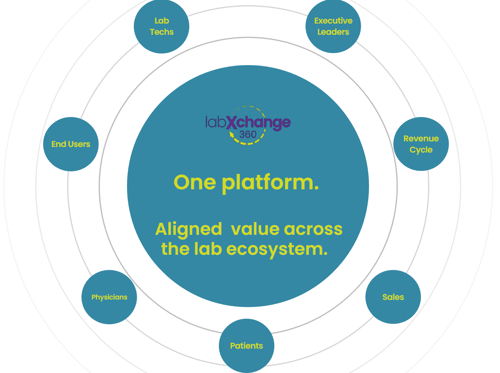
One of the most important opportunities in laboratory healthcare today is not necessarily another standalone tool. What wins is orchestration and connecting the systems that laboratories already depend on:
- LIS
- RCM platforms
- EMRs
- Commercial systems
- Ordering workflows
- Eligibility and payer data
And creating real-time automation and visibility between them. This is where meaningful operational transformation is happening now. At LabXchange360, this is exactly the problem we are focused on solving.
By connecting systems and automating upstream validation workflows, laboratories can improve laboratory revenue optimization efforts while reducing operational friction. Organizations can:
- Reduce preventable lab claim denials
- Improve clean claim rates and laboratory billing accuracy
- Eliminate manual work
- Incrase operational visibility
- Improve turnaround times
- Strengthen financial performance without increasing headcount
And most importantly, these improvements are available today, not years from now.
The Cost of Waiting
One of the strongest takeaways from Executive War College was that many organizations are still in “wait-and-see” mode when it comes to workflow automation; waiting for broader AI maturity, the perfect enterprise platform, budget cycles, or for payer conditions to stabilize.
But the operational and financial challenges facing laboratories are already here. We see them in delayed eligibility checks, incomplete orders, preventable authorization issues, and disconnected workflows. These are all forms of revenue leakage happening in real time.
Labs that continue relying on fragmented processes are actively losing margin.
Looking Ahead
Executive War College reinforced an important reality:
The future of laboratory RCM will absolutely include AI. But the organizations that win in the near term will be the ones that solve foundational workflow and operational challenges first. Automation, connectivity, and real-time workflow visibility are available now.
And increasingly, they are becoming the difference between reactive revenue cycle management and proactive financial performance.
At LabXchange360, we believe the next generation of laboratory operations will be built around financially validated testing, intelligent workflow orchestration, laboratory workflow automation, and upstream automation that prevents revenue problems before they occur.
That future of lab operations is here. The question is which labs are ready to act on it.
***
Frequently Asked Questions About Laboratory Revenue Cycle Management
What is laboratory revenue cycle management automation?
Laboratory revenue cycle management automation involves using integrated software, workflow orchestration, and real-time data validation to reduce manual processes and improve reimbursement outcomes throughout the laboratory billing lifecycle. This includes automation of eligibility verification, prior authorization, medical-necessity checks, order integrity, and claims workflow management.
How can labs reduce claim denials?
Labs can reduce claim denials by improving upstream workflow controls prior to testing. Common strategies include automated insurance eligibility verification, real-time order validation, automated prior authorization, and medical-necessity screening. Preventing incomplete or incorrect orders upfront helps improve clean claim rates and reduce downstream billing errors.